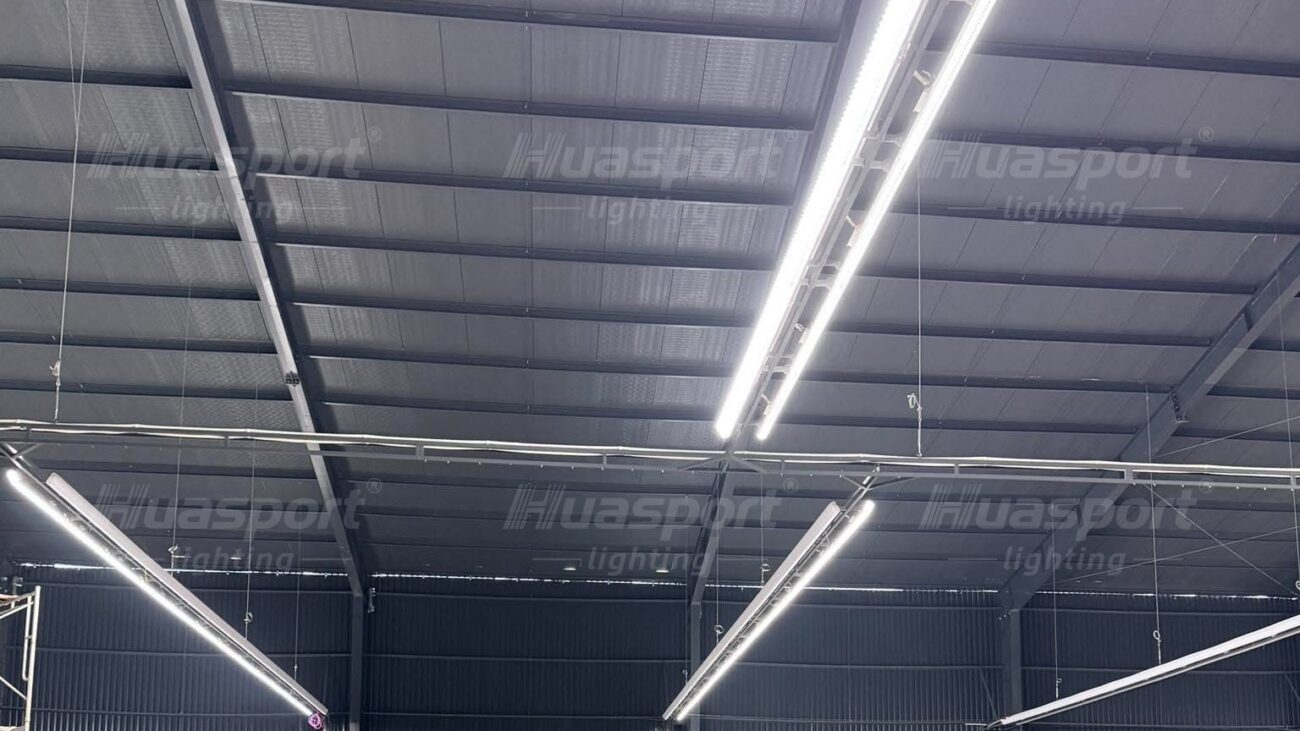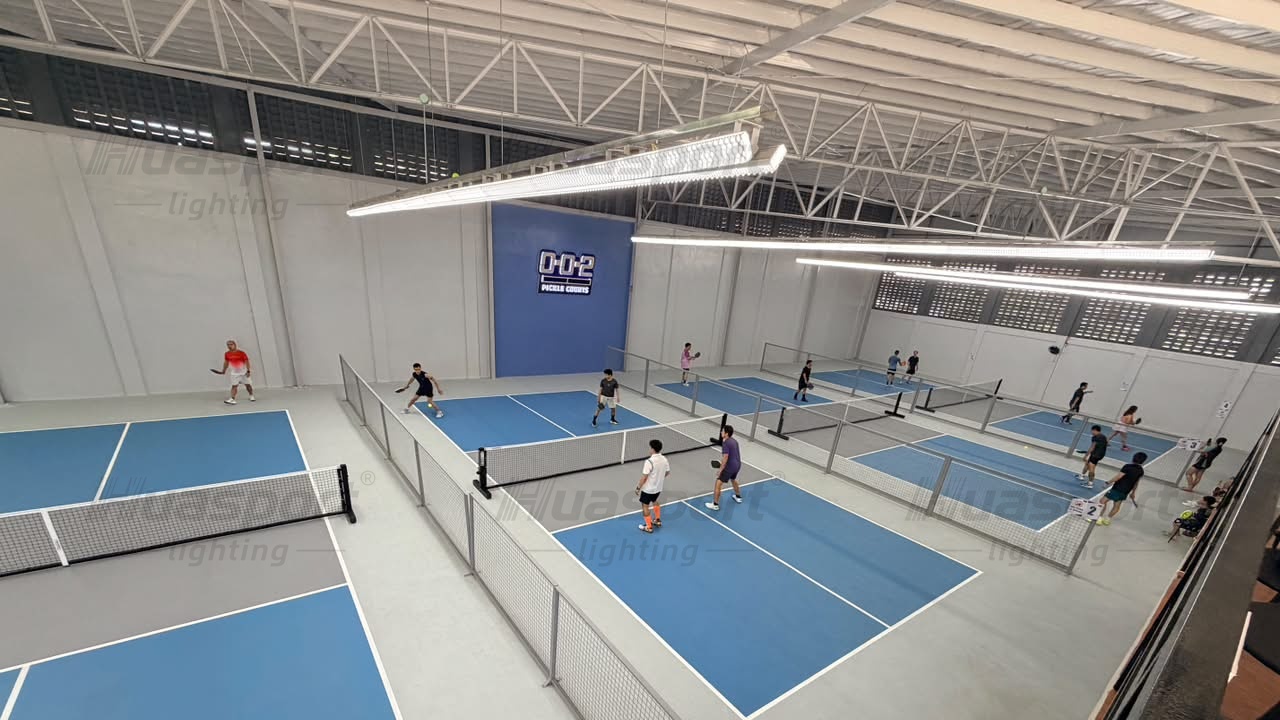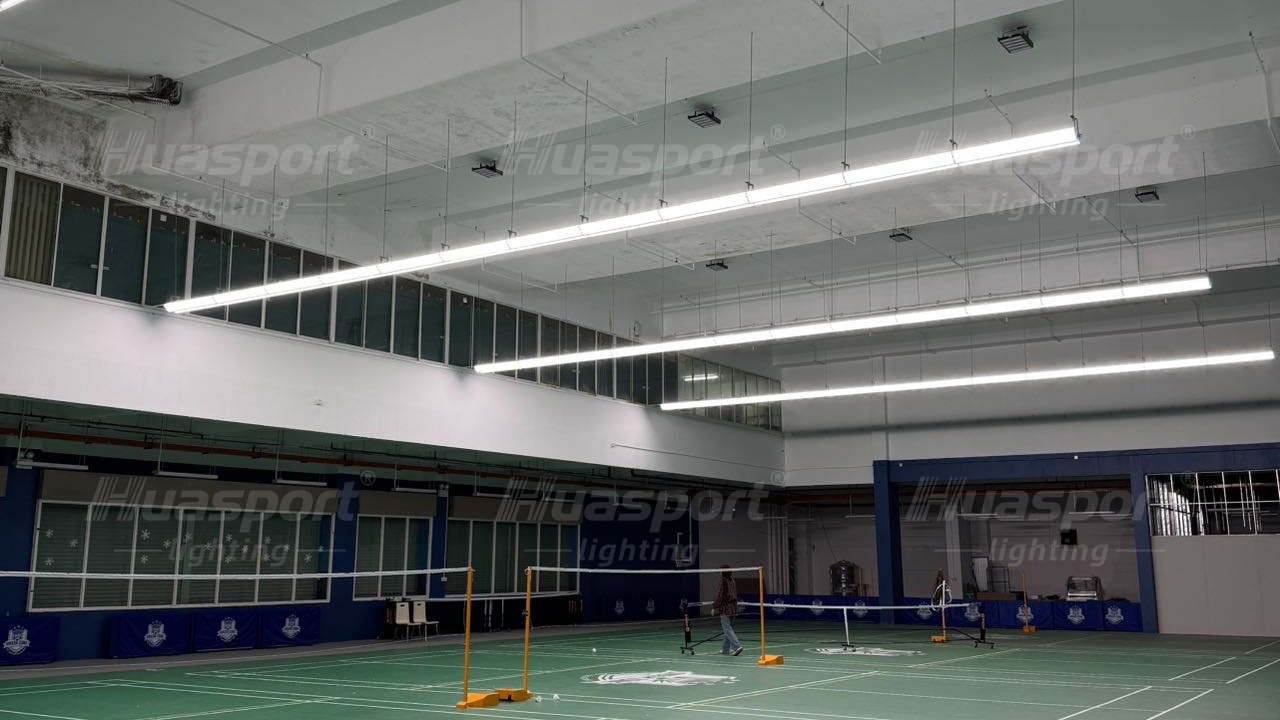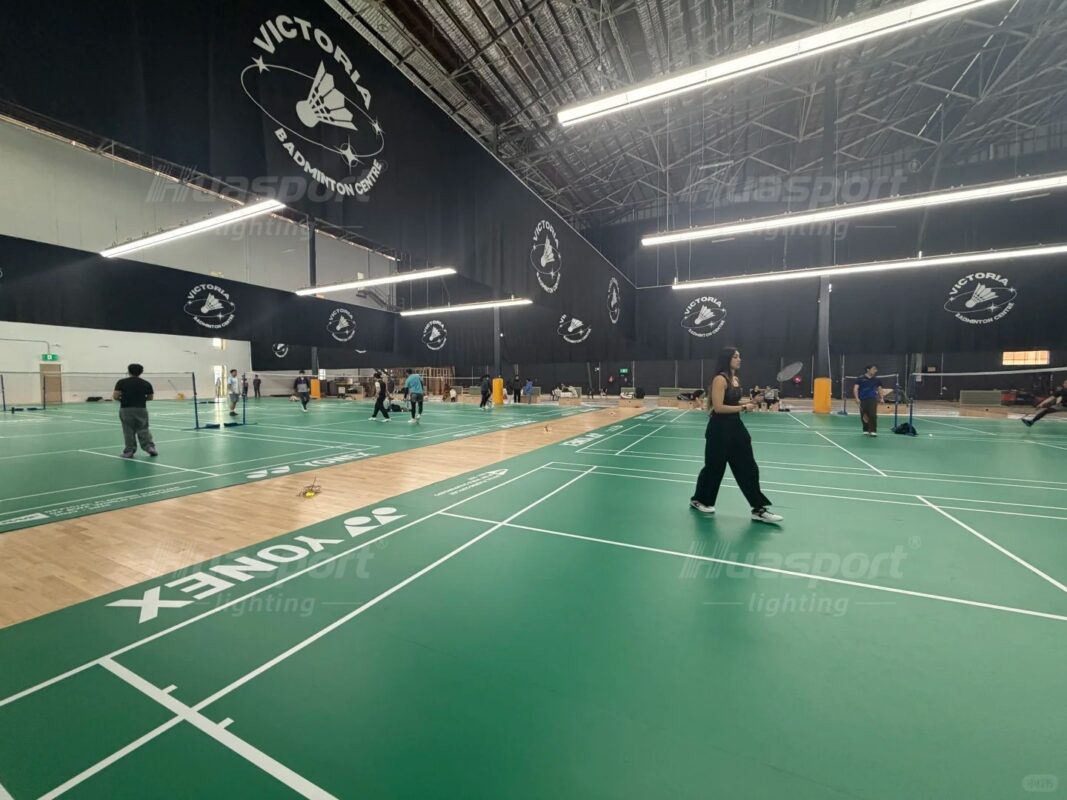
 Badminton/Pickleball court lights
 Pickleball court lights
 Padel Court Lights
 Basketball court lights
 Tennis court lights
 Football field lights
Philippines Badminton Court Lighting: S90 42W High-Shuttle Tracking Checks

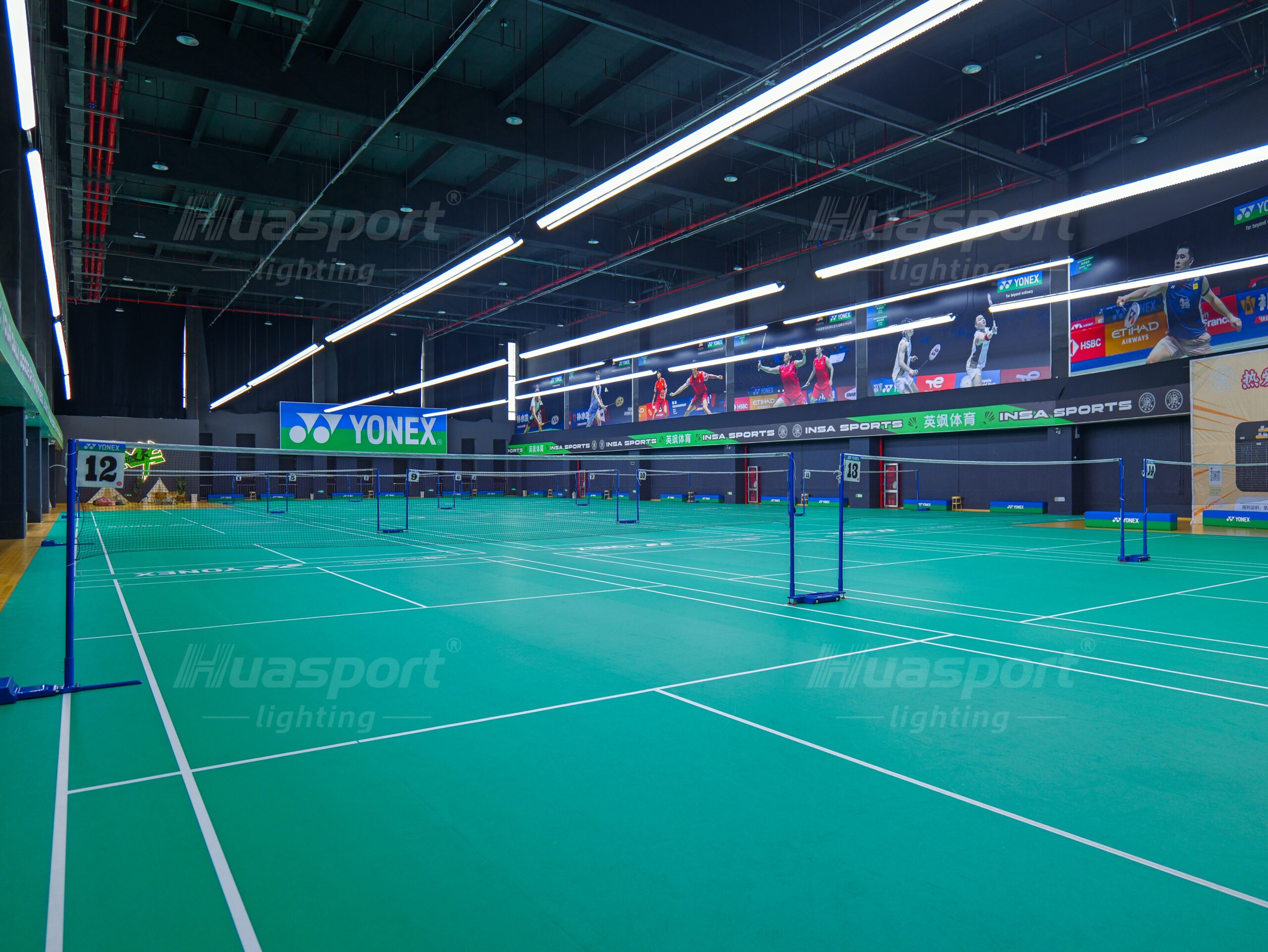
In a Philippines badminton hall, a court can look bright from the aisle and still feel uncomfortable from the rear court. The real test starts when a player looks up for a clear, a lift or an overhead shot and has to track the shuttle under long bright fixture rows.
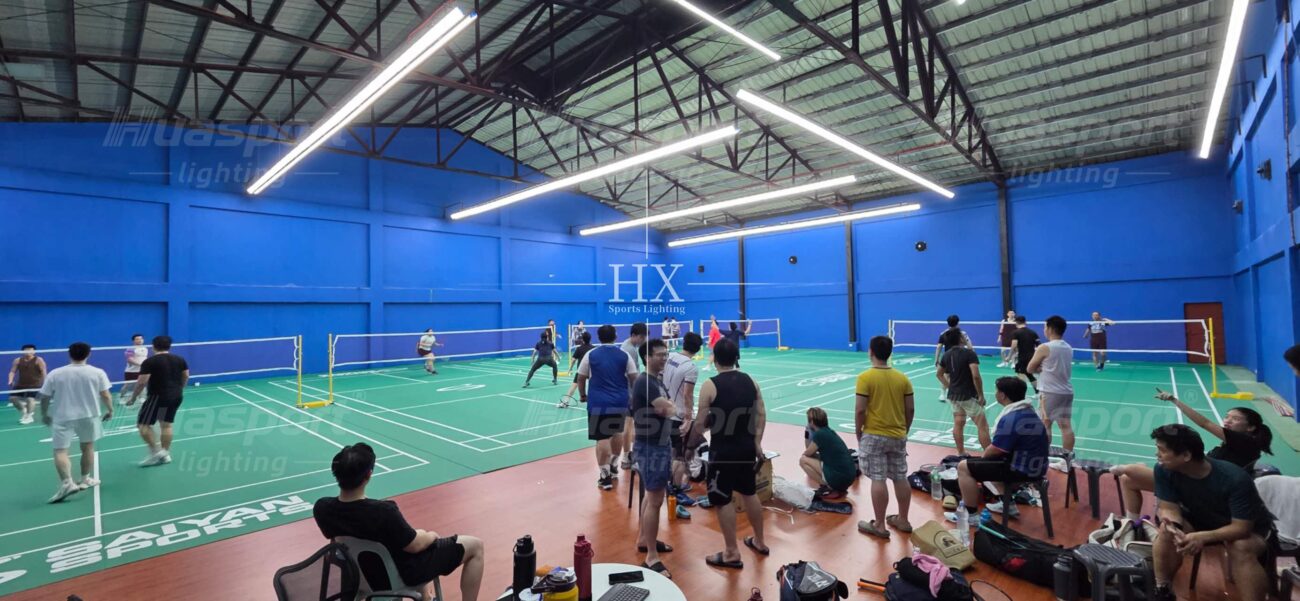
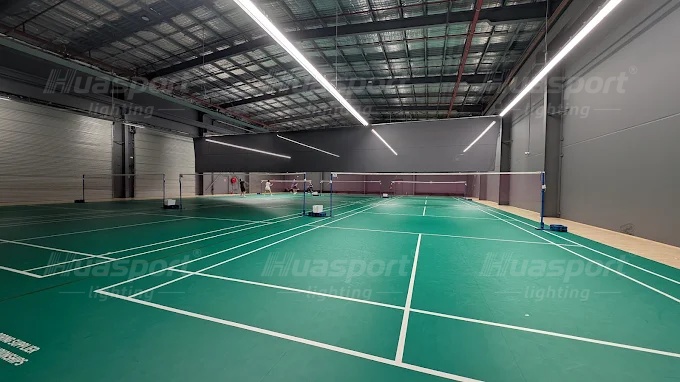
For this Philippines indoor badminton court lighting review, one practical Huasport planning option uses the WM-S90-1160-DD-42W-108Z long-bar fixture. The reference layout uses 24 fixtures per court, 12 fixtures on each side, 5 m mounting height and 30-degree inward aiming. The goal is not only to light the floor. It is to help the player keep the shuttle in view without a harsh side line pulling the eye away.
Start From the Player View, Not the Doorway
A doorway check can be misleading. From the entrance, the floor may look clean, the lines may look sharp and the hall may feel bright enough. A player sees something different. The player stands near the back line, looks upward, and tracks the shuttle against the roof, beams, side walls, banners and neighboring rows.
That is why a useful Philippines badminton court lighting check should include three positions: rear court, sideline and the space between neighboring courts. Stand in each position and look up along the expected shuttle path. If the eyes keep jumping toward the fixture row instead of following the shuttle, the layout needs review.
The Huasport Badminton Court Lighting guide follows the same logic: fixture quantity, row length, mounting height, aiming angle and player comfort should be checked together.
The S90 42W Planning Reference
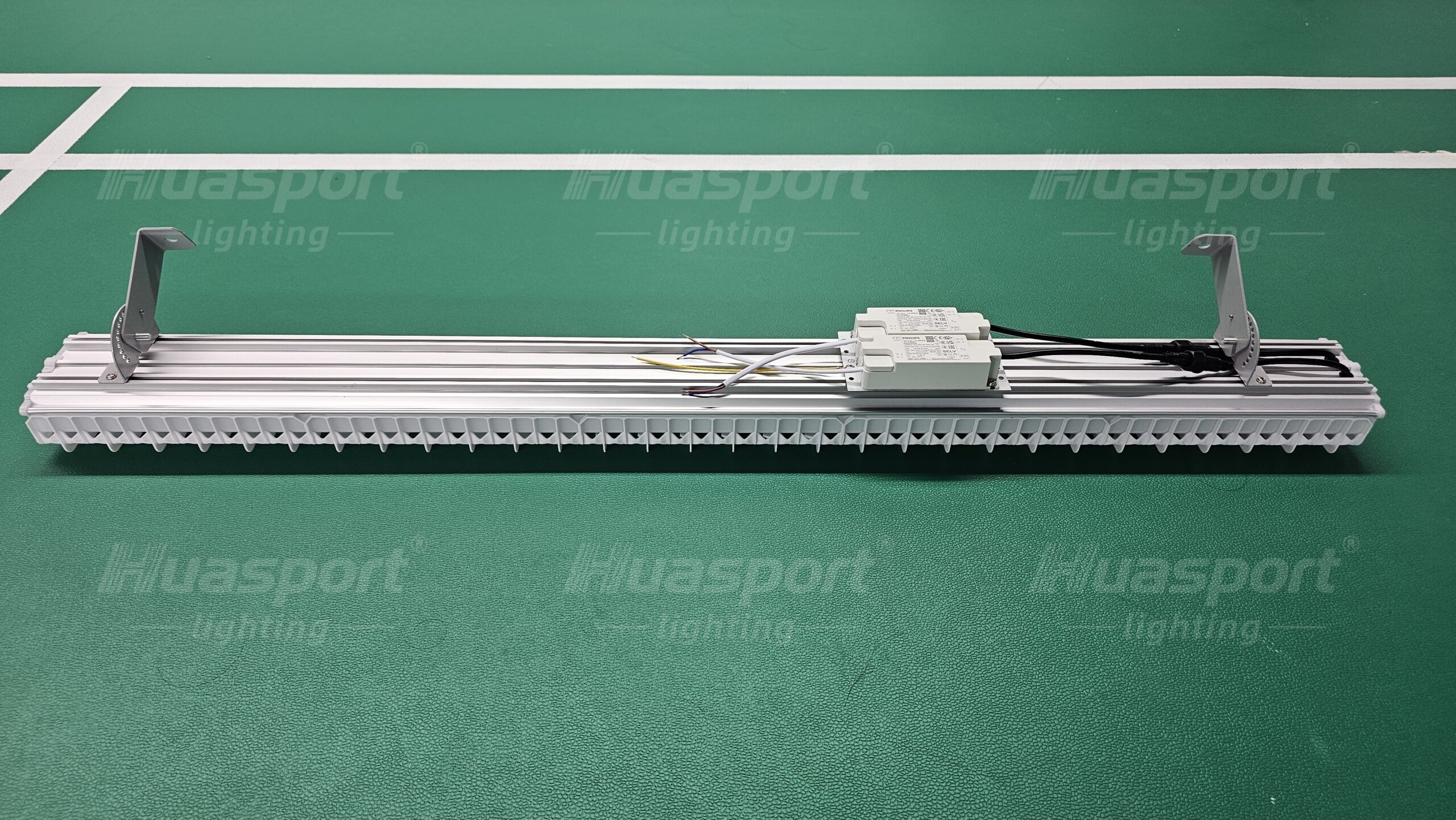
This article uses the Huasport WM-S90-1160-DD-42W-108Z as a planning reference for indoor badminton courts in the Philippines. It is a 1.16 m S90 long-bar fixture with a 13 cm body width and a double-layer honeycomb grille.
The layout places one continuous row along each side of the court. Each side uses 12 fixtures. Twelve 1.16 m fixtures form a 13.92 m row, which covers the 13.4 m main playing-area side of a badminton court.
| Item | Philippines Planning Reference |
|---|---|
| Fixture model | WM-S90-1160-DD-42W-108Z |
| Fixture family | S90 1.16 m long-bar fixture |
| Body width | 13 cm |
| Power | 42W |
| Fixtures per court | 24 fixtures |
| Fixtures per side | 12 fixtures |
| Mounting height | 5 m |
| Aiming | 30-degree inward aiming |
| Row length | 13.92 m continuous row |
| Main playing-area side covered | 13.4 m |
| Planning illuminance | 300-400 lux+ |
| Competition review | Review 500 lux+ target separately if required |
This is a planning option, not a claim that every Philippines case photo proves the exact installed model. Photos can show hall shape, row direction, wall background and player sightlines. The exact model, fixture count, suspension structure and acceptance target still need to be confirmed before quotation.
Why High-Shuttle Tracking Feels Different From Floor Brightness
Badminton is not played with the eyes fixed on the floor. Clears, lifts, serves and smashes all push the player view upward. If the fixture row sits in the same upper field of view as the shuttle path, the player may feel glare even when the court surface measures bright enough.
This is why the conversation should not start with wattage alone. A buyer should ask where the row hangs, how far it sits from the court line, how it is aimed, and whether the player can track a high shuttle from the rear court without discomfort.
In multi-court halls, the next court also matters. A row intended for one court can still enter the sightline of the neighboring court. A center court may receive light from both sides, while an end court sits beside a wall or aisle. The same fixture list can therefore feel different from court to court unless each court is checked from the playing positions.
Direct-View Glare and Side Glare Need Separate Checks
Venue owners often use the word glare for two different problems.
Direct-view glare happens when the player looks toward the fixture face during a serve, clear, lift or overhead shot. This should be checked from the back court and from both sidelines.
Side glare happens when a long row runs along the court and the player sees the side of the fixture while moving across the rear court or looking toward the next court. This is one reason the optical structure matters on long-bar badminton fixtures.
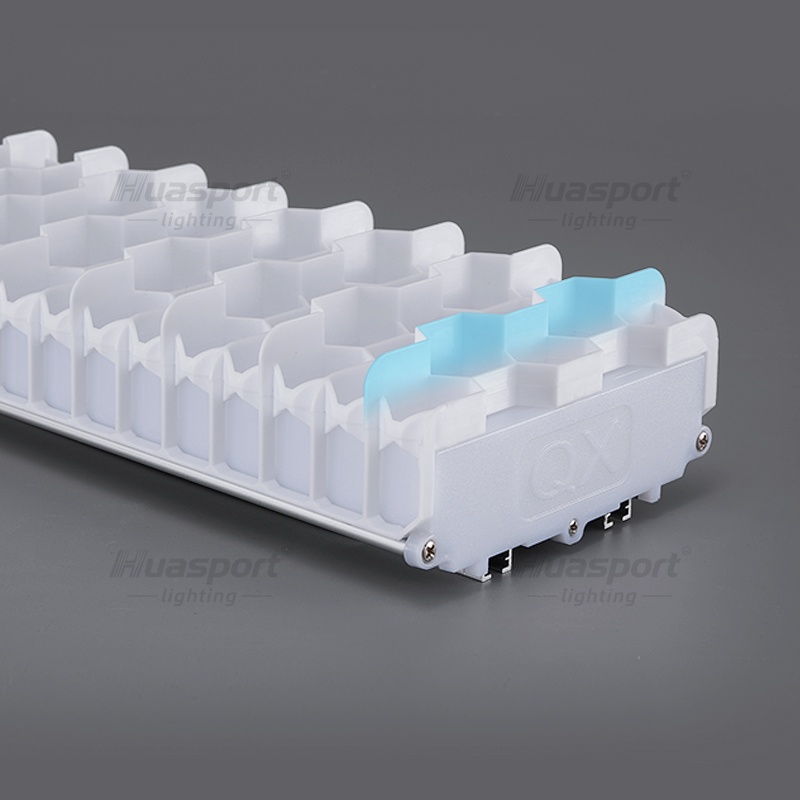
The S90 double-layer honeycomb grille is designed to reduce side glare from player viewing angles. It should not be described as making every angle glare-free. A real hall still needs a player-view check after the rows are placed and aimed.
Why the 13 cm S90 Body Helps the Optical Structure
The S90 body width is 13 cm. That width gives the optical structure more room than a very narrow body would, especially when the fixture needs a double-layer grille rather than a simple single layer. In practical terms, the grille is there to make the side view calmer when players repeatedly look up and across the court.
This is also why the product should not be reduced to power only. Two fixtures with similar wattage can feel different if their optical structure, row position and aiming angle are different. The fixture body, grille depth, mounting height and court layout all affect what the player actually sees.
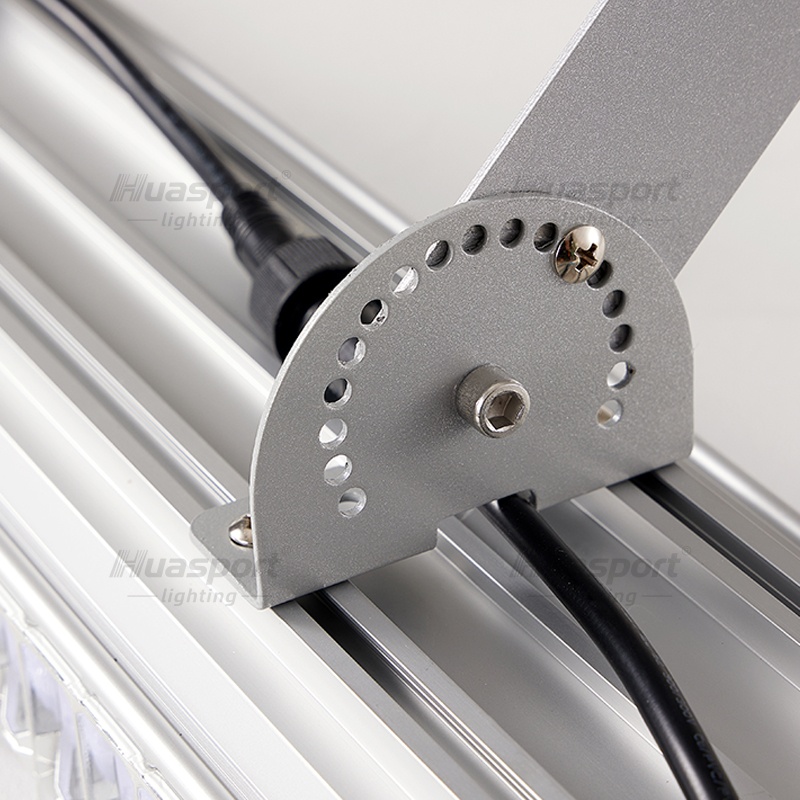
For the 5 m reference layout, the rows should be aimed inward at 30 degrees. The adjustable bracket should make that aiming repeatable from fixture to fixture. On Huasport long-bar fixtures, the bracket is fixed to the aluminum profile, giving the row a stronger fixing base than a weak plastic section would provide.
What Buyers Should Confirm Before Quotation
Before a Philippines badminton hall asks for a final quote, these items should be confirmed:
- Confirm the number of courts and whether the hall has wall-side, end-court or middle-court differences.
- Confirm whether the project is for training, club play or competition use.
- Confirm the planning model as WM-S90-1160-DD-42W-108Z.
- Confirm 24 fixtures per court, with 12 fixtures on each side.
- Confirm 5 m mounting height and the available roof or suspension structure.
- Confirm 30-degree inward aiming on both side rows.
- Check rear-court, sideline and neighboring-court player views, not only doorway brightness.
- Confirm whether 300-400 lux+ is enough, or whether 500 lux+ should be reviewed for competition use.
These checks keep the quote practical. They also reduce the risk of choosing a layout that looks bright in photos but feels harsh during high-shuttle play.
What the Philippines Photos Can and Cannot Prove
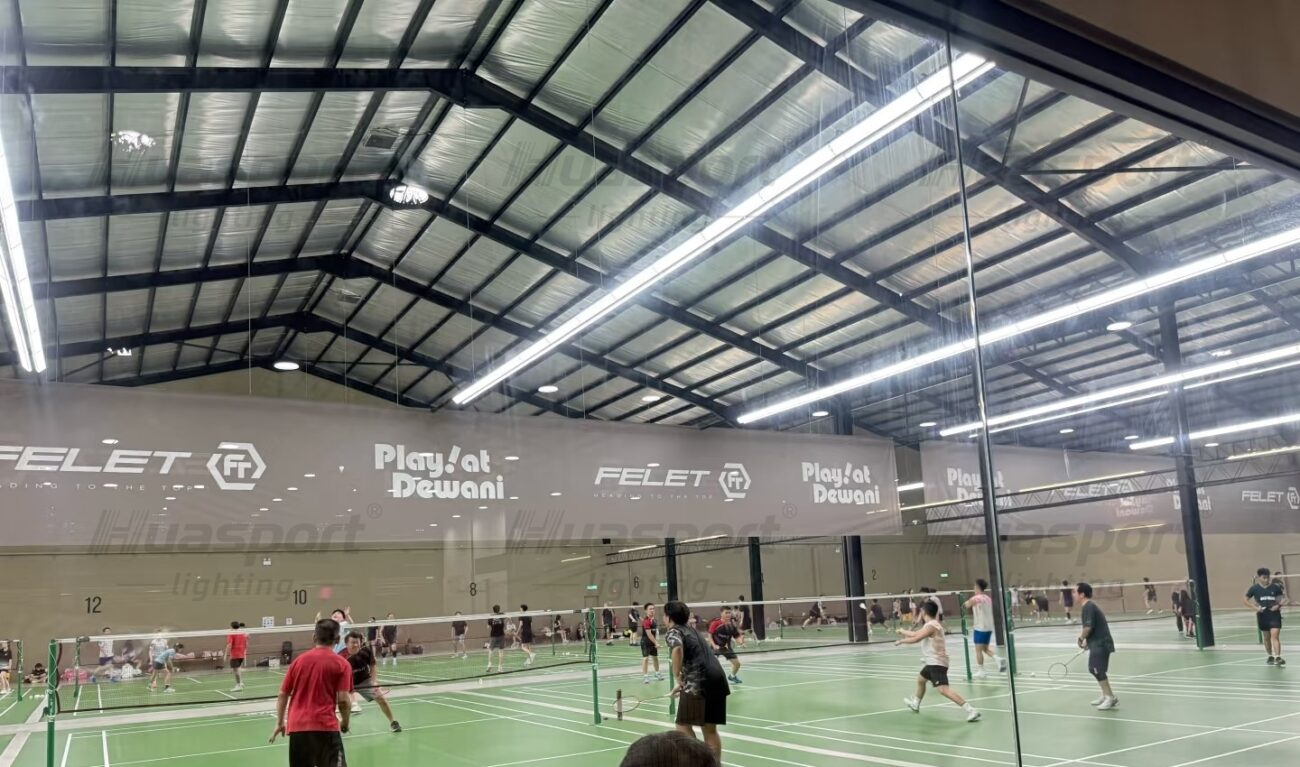
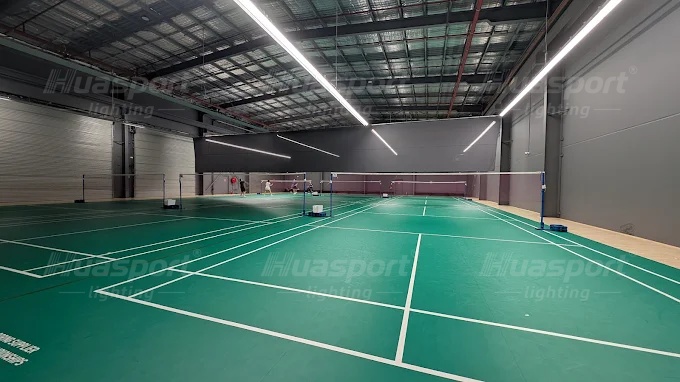
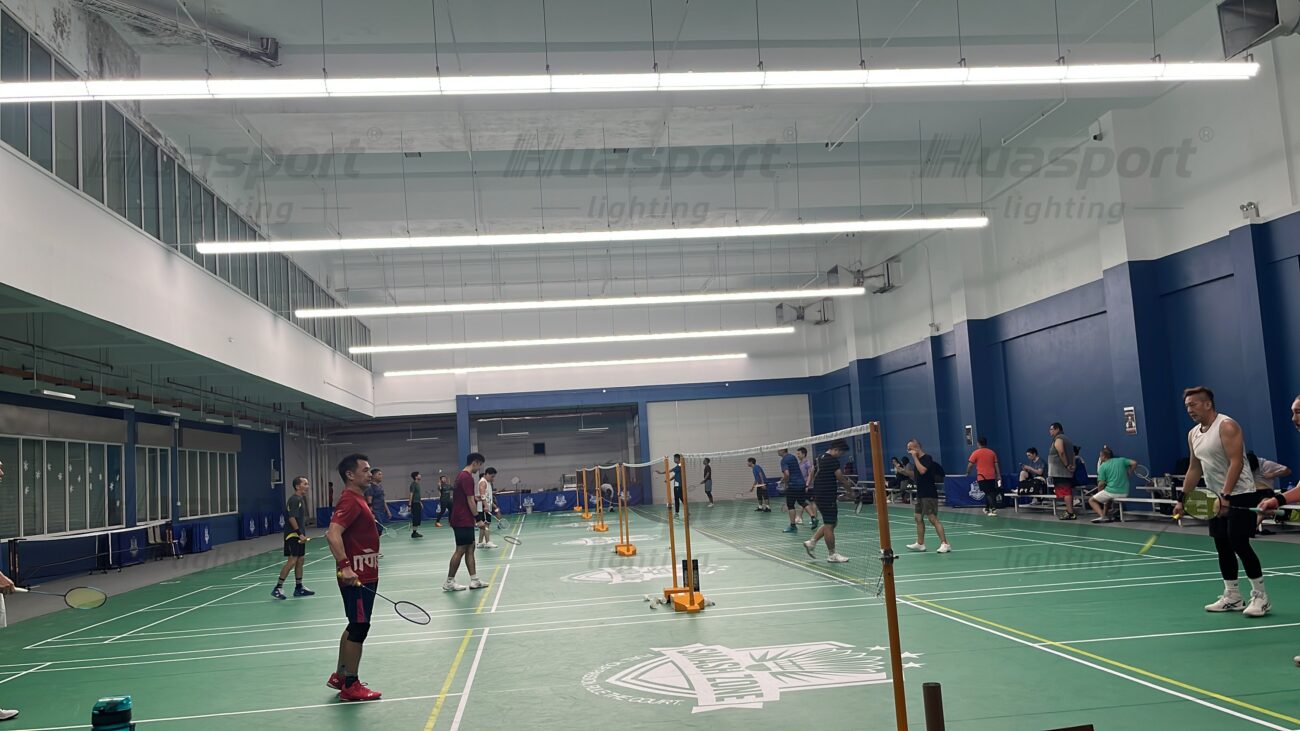
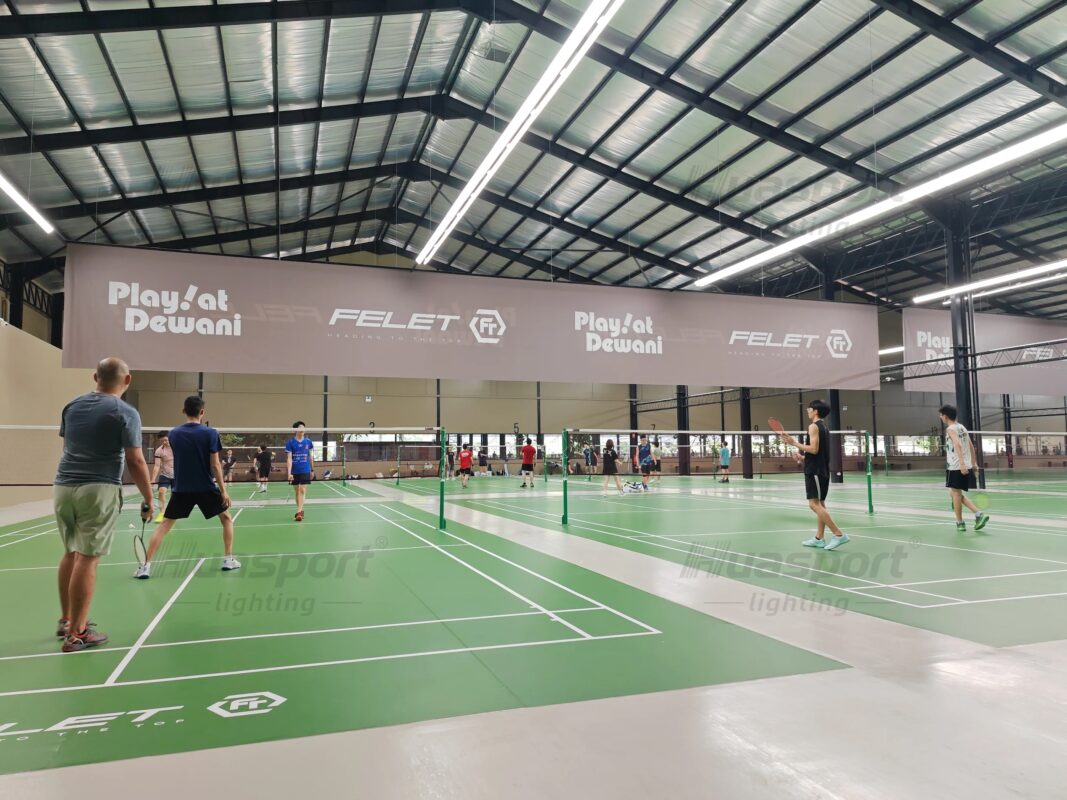
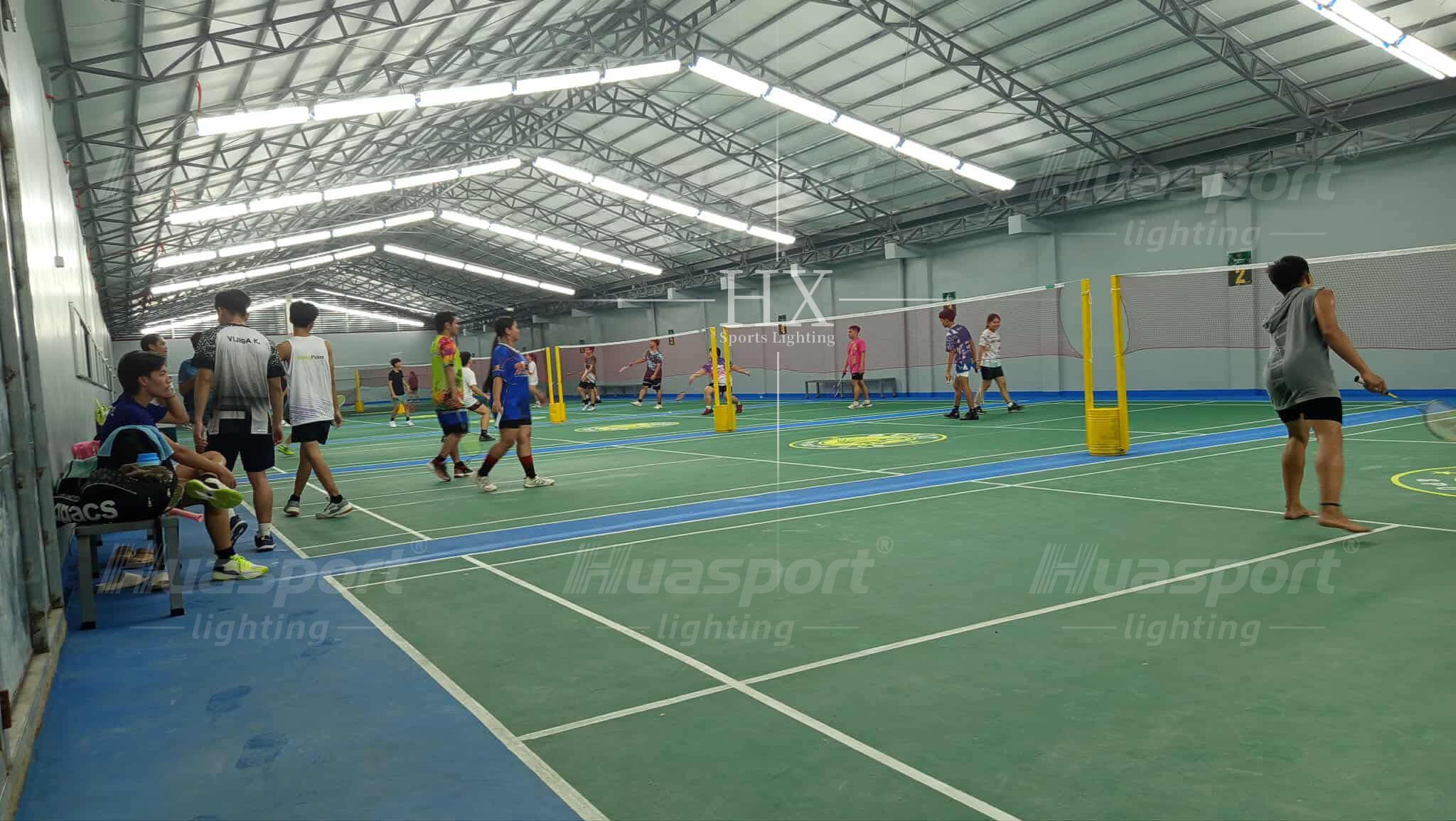
The Philippines case photos are useful because they show real indoor badminton environments with visible long-bar rows, court spacing, ceiling structure and player sightlines. They help buyers picture where glare questions appear in a working hall.
They do not prove every technical detail by themselves. A photo does not confirm the exact model code, fixture count, output or final acceptance reading unless those details are supported by project records. For that reason, this article treats the images as same-country environment references and keeps the technical data as a planning option.
That distinction is important. It keeps the article honest, and it helps the buyer ask better questions before the quote is locked.
Where Pickleball and Padel Differ
The same player-view habit helps other sports, but the layout should not be copied without checking the sport. Pickleball has a lower net, a different ball path and a different rhythm, so buyers should compare it with the Huasport Pickleball Court Lighting guide instead of assuming the badminton row layout is automatically correct.
Padel is different again. Glass walls, fencing and four-side lighting create reflection and side-view problems that are not the same as a two-side badminton layout. For that reason, the Huasport Padel Court Lighting layout uses its own 50-fixture court logic.
For Philippines badminton projects, keep the discussion narrow and checkable: WM-S90-1160-DD-42W-108Z, 24 fixtures per court, 12 fixtures per side, 5 m mounting height, 30-degree inward aiming, 13.92 m continuous rows, 300-400 lux+ planning reference, and a player-view check from the rear court before final quotation.
For project discussion, contact Huasport Lighting. For more court lighting planning notes, visit the Technical Articles archive.