 Badminton/Pickleball court lights
 Pickleball court lights
 Padel Court Lights
 Basketball court lights
 Tennis court lights
 Football field lights
Australia Multi-Court Badminton Hall Lighting: SAA S70 60W Rows at 6 m

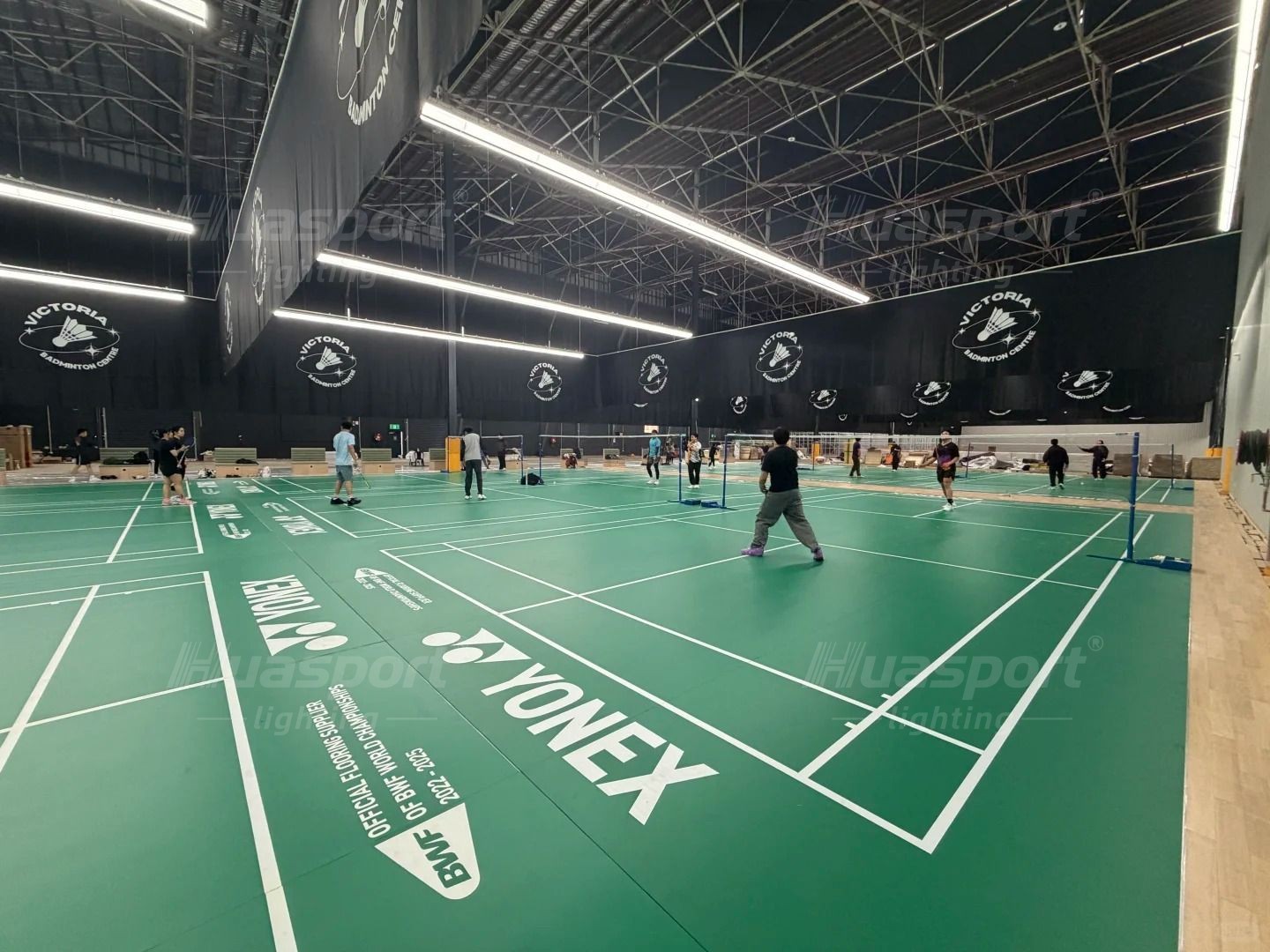
A hall with twenty badminton courts under one roof does not get lit one court at a time. The fixture rows run in long parallel lines along the side walls, and the planning decision at quotation stage is how those lines are divided across the whole building.
That decision is what this page covers. The layout for a single court is already settled. What changes in a large hall is how many rows belong to one block of courts, where the block boundaries fall, and which settings have to stay identical from the first court to the last.
The Data for One Australian Court
For indoor badminton in Australia, one Huasport SAA layout option uses the S70 1.16 m 60W long-bar fixture, model SAA-S70-1160-FLP-60W-108Z, with an 11 cm body and a rated output of 5130 lm.
One court takes 24 fixtures, with 12 fixtures on each side. The sides are mounted around 6 m and aimed 30 degrees inward toward the playing area. Twelve 1.16 m fixtures form a 13.92 m continuous row per side, and that row length is used to cover the 13.4 m main playing-area side length. The planning target for commercial and recreational play is 400-500 lux+ average illuminance. Where competition use is planned, the design should be reviewed toward 500 lux+ before the quotation is fixed.
Those figures are per court. In a hall with twenty courts the same figures repeat twenty times, and that repetition is where most of the planning work sits.
Why Twenty Courts Cannot Be Planned Court by Court
Twenty courts at 24 fixtures each is 480 fixtures, and they do not sit in twenty separate rooms. Neighbouring courts share the same structural bay, the same side wall and the same run of purlins along the roof frame.
In practice the rows for two adjacent courts sit on one continuous line of structure. An installer works along that line, and the bracket setting used on the first court carries straight into the second, whether or not anyone intends it to.
That makes two things worth marking on the drawing before installation starts. The first is where a block of courts ends. Block boundaries usually fall on a structural bay, a walkway, a change of floor colour or a gap between court groups. The second is which courts share one continuous run of structure, because those are the courts where the aiming angle is most likely to drift.
Where the Row Sits, and What the Bracket Controls
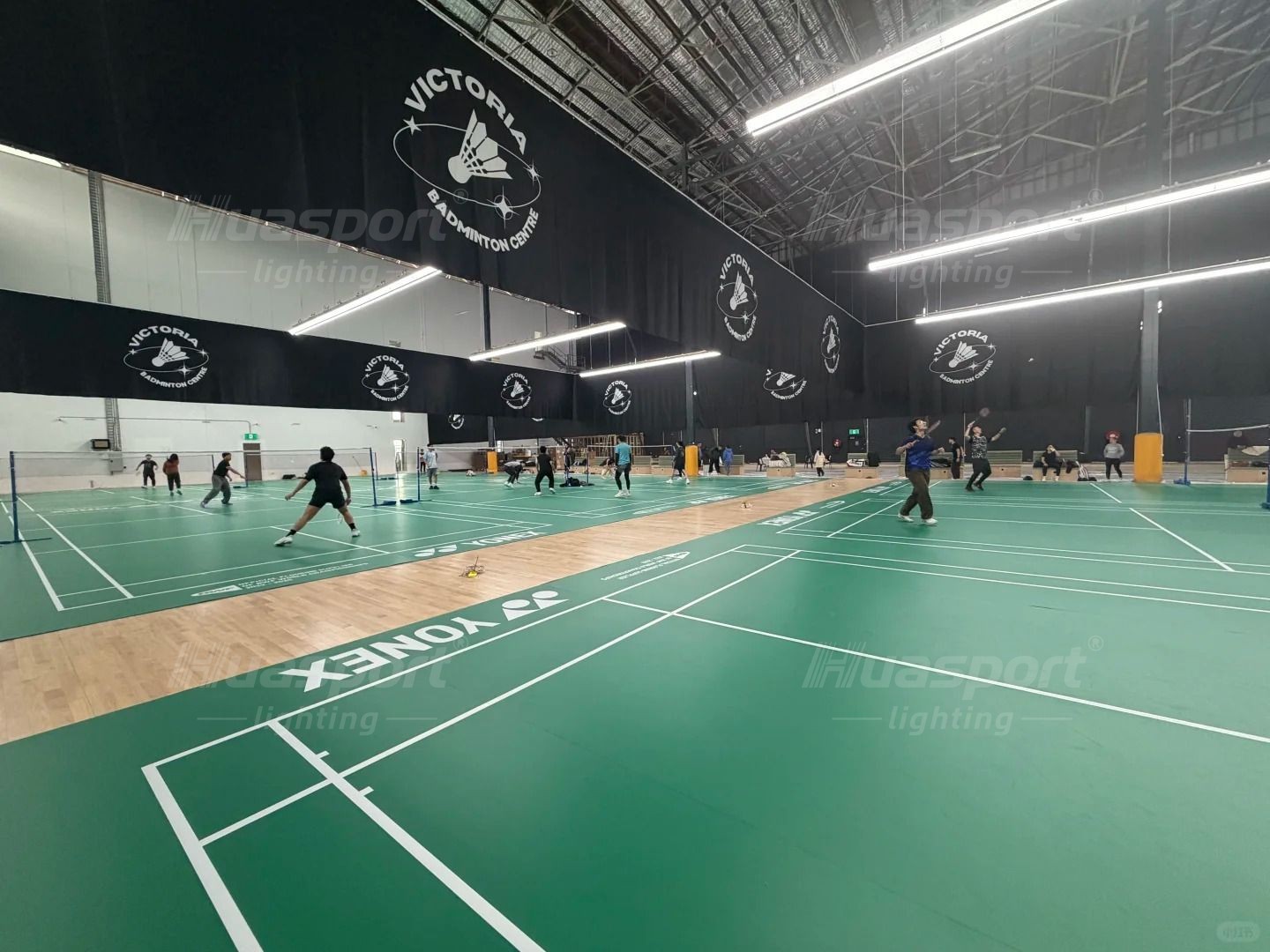
The Australia photos show the rows running along the long sides of the court blocks at roughly 6 m, fixed to the structural wall and roof frame rather than hung from the middle of the ceiling. Side mounting changes two things.
The first is the aiming angle. The 30-degree inward tilt is set at the bracket, not at the driver. In normal installation the bracket locks around the 6th hole position to hold that angle. On a side-mounted row that angle decides how far the light reaches across the playing area before it falls away.
The second is what a player sees. Because the row sits beside the court rather than above it, the fixture body is closer to the line of sight from the baseline. This is the check a specification sheet cannot answer, and it takes about five minutes per court on site.
Aiming the Same Way on Every Court
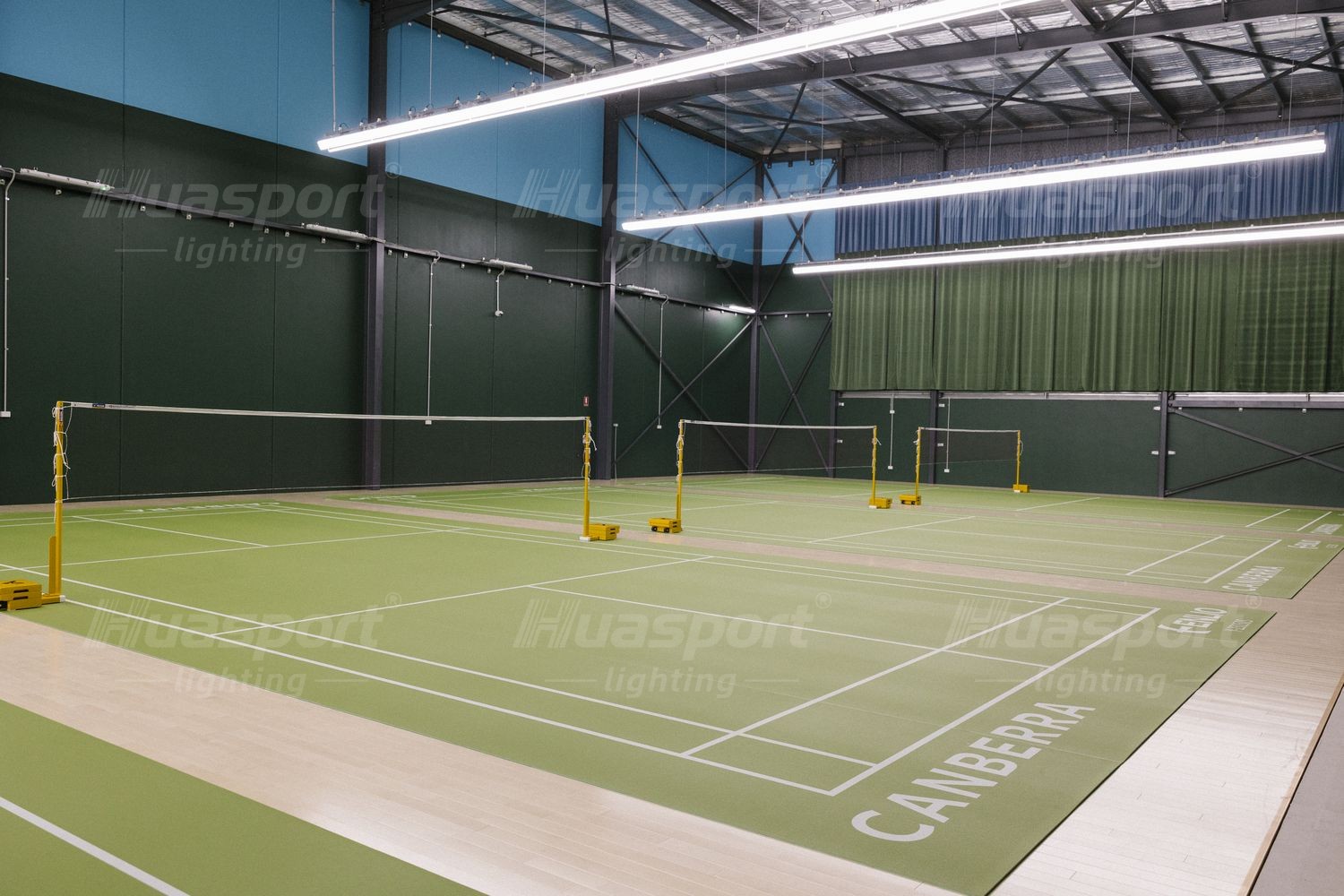
Twenty-four fixtures per court only works as a system when both side rows aim the same way. Set one court at 30 degrees and leave the next one flatter, and players moving between courts feel the difference even when the fixture counts match.
The adjustable bracket is what makes the setting repeatable. Locking it at the 6th hole gives installers a reference for the 30-degree inward aim, so the second and the twelfth court can copy the first without another discussion at height.
What the 60W S70 Adds to a Large Hall
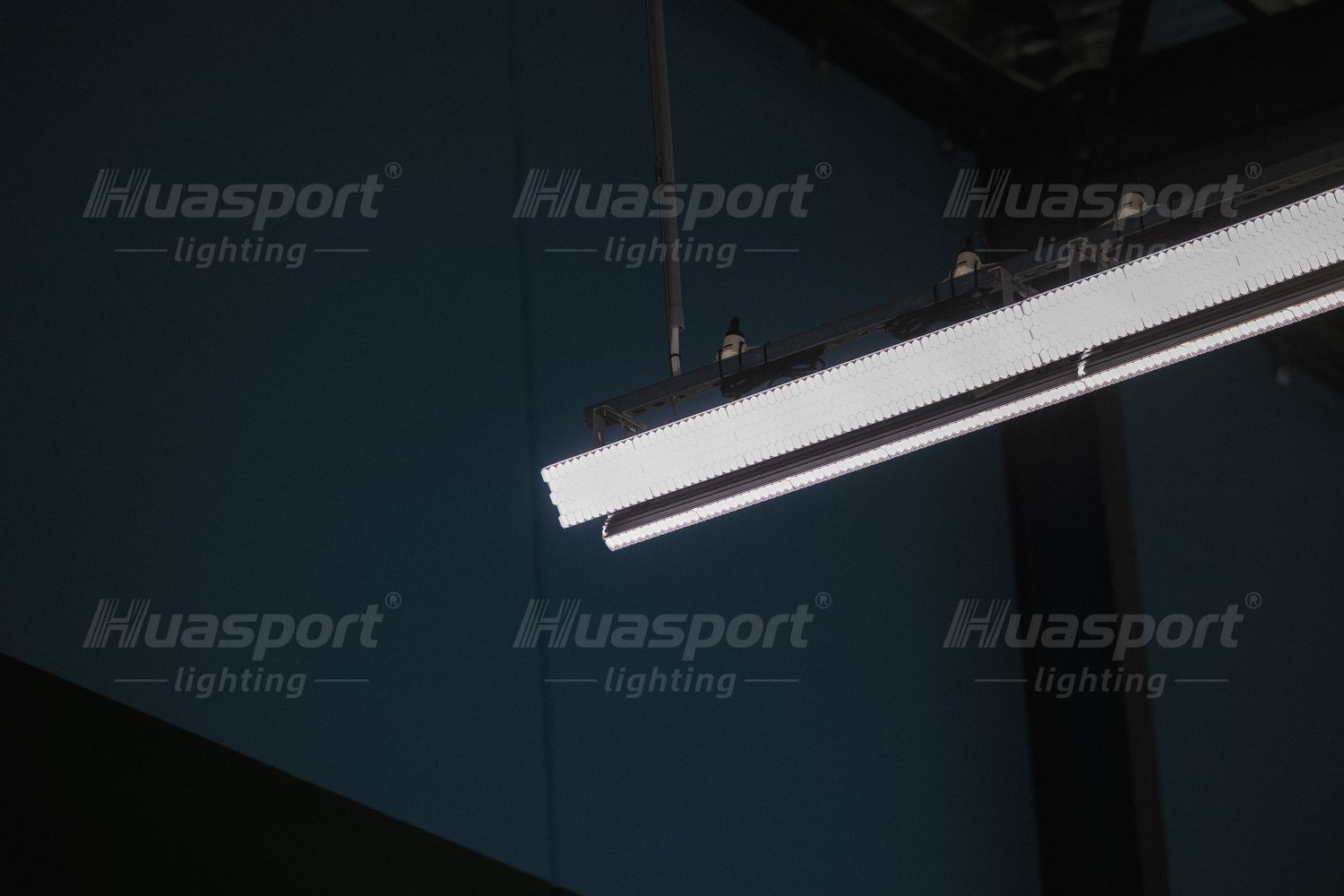
S70 and S90 share the same long-bar anti-glare design. The S70 body is 11 cm wide, the S90 body is 13 cm. This plan uses the narrower S70 at 60W in the SAA configuration, which suits halls where a long run of fixtures has to sit inside an existing structural line.
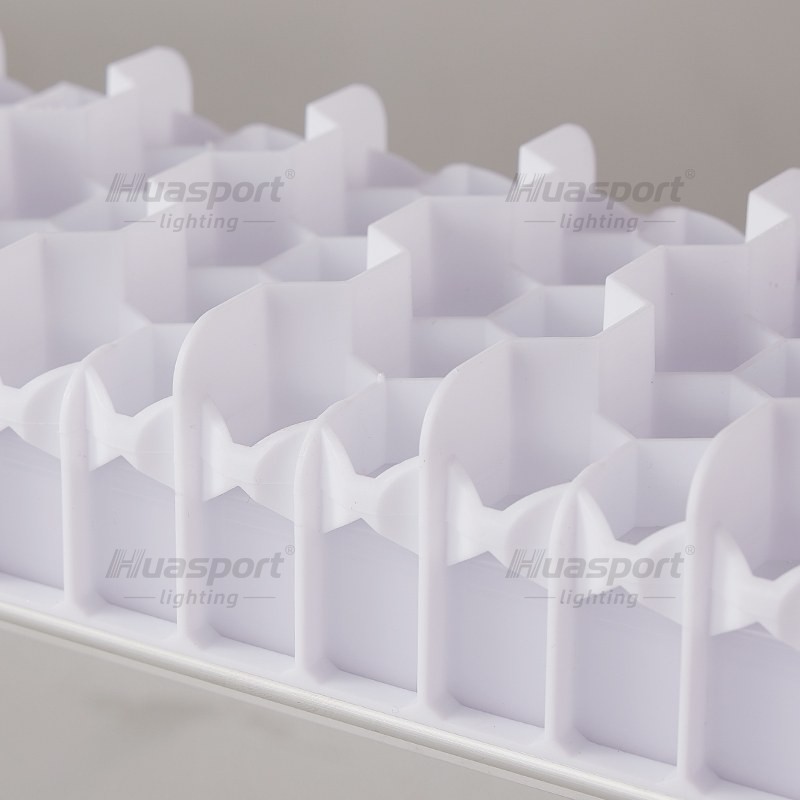
The front of the fixture carries Huasport’s double-layer honeycomb grille. Two grille layers give the light a longer path before it leaves the fixture, which is what softens the direct view of the LED source when a player looks up. The back uses a thickened aluminum profile rather than a folded iron body, and the bracket fixes into that aluminum section instead of plastic, so the mounting point does not sit on a small plastic insert.
The Layout in Numbers
| Item | Reference Data |
| Country application | Australia indoor badminton hall |
| Hall type | Large hall with several court blocks |
| Fixture model | SAA-S70-1160-FLP-60W-108Z |
| Fixture family | Huasport S70 long-bar anti-glare |
| Certification context | SAA |
| Body width | 11 cm |
| Power | 60W |
| Rated output | 5130 lm |
| Fixture length | 1.16 m |
| Quantity per court | 24 fixtures |
| Side layout | 12 fixtures on each side |
| Row structure | Continuous row, no visible gap |
| Row length per side | 13.92 m |
| Main playing-area reference | 13.4 m side length |
| Mounting reference | Around 6 m |
| Aiming reference | 30-degree inward, bracket 6th hole |
| Commercial-use target | 400-500 lux+ average illuminance |
| Competition-use reference | 500 lux+ average illuminance after final review |
What the Australia Case Photos Show
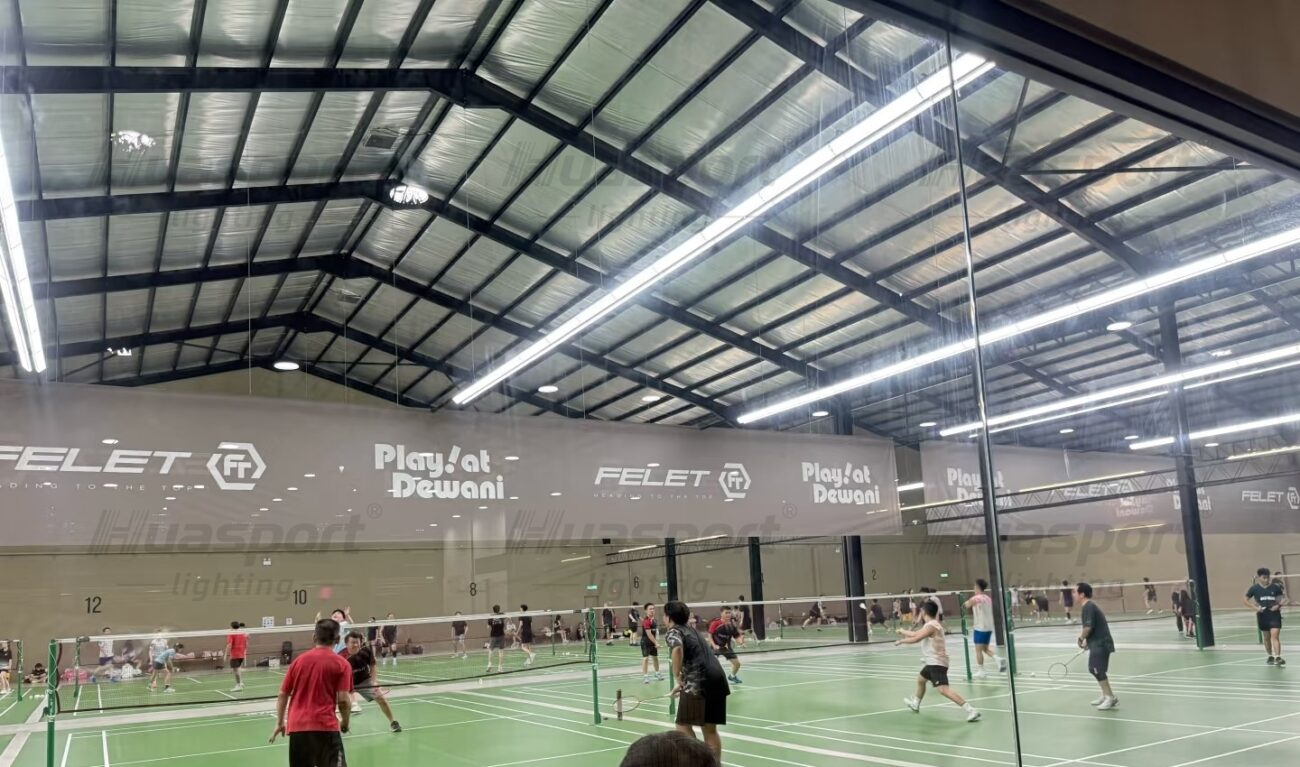
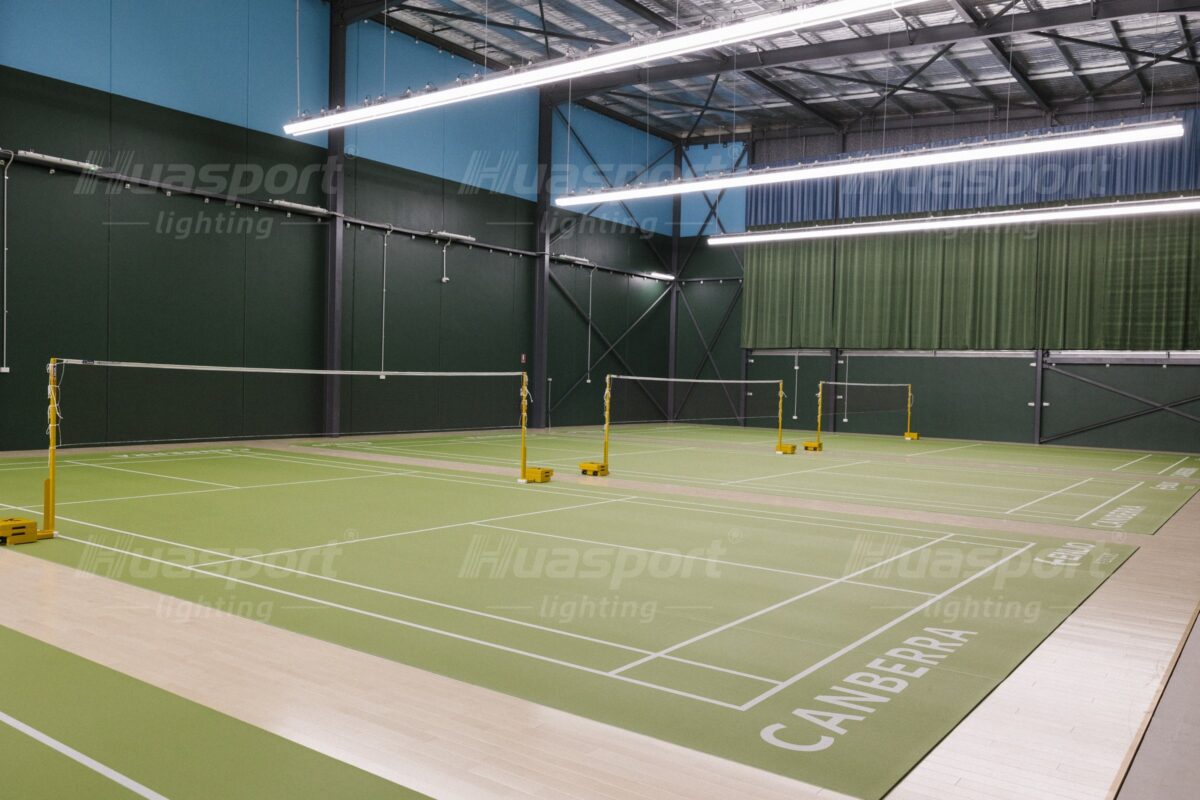
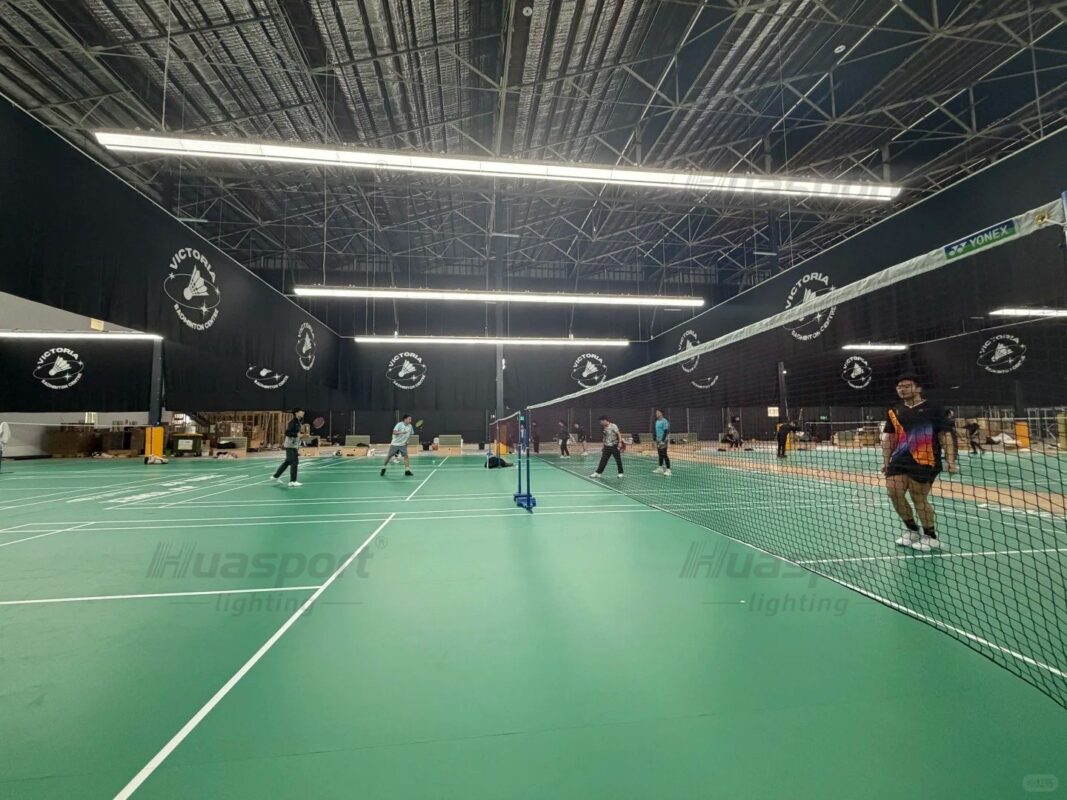
The photo set covers a multi-court hall with rows running along both long sides, a wide view across several courts where the rows follow the side structure, a single court with the side row aimed in over the playing area, and a close view of an installed fixture with its bracket.
Between them they answer the questions a drawing handles badly. How much structure sits above the row. How far the row sits from the side line. Whether the fixture body stays in view from where the players stand.
The photos do not confirm the installed model. That comes from the quotation, the model code and the layout drawing. What the photos do is make the site conversation concrete before the numbers are fixed.
Acceptance Checks for a Multi-Court Hall
- Every court carries the same fixture count on both of its side rows.
- The 30-degree bracket setting matches on both sides of every court, not just the first one.
- Each row covers the long side of its own playing area from end to end.
- No fixture body sits in the direct line of sight from the baseline.
- The illuminance target is written down for the intended use, with 400-500 lux+ for commercial and recreational play and a 500 lux+ review where competition use is planned.
Five checks, one afternoon, and most of the arguments that follow an installation are settled before it starts.
Where This Fits With Other Huasport Court Lighting Pages
For the venue itself, the Huasport badminton court lighting guide is the core page for side-row layouts and the aiming reference used on shuttle courts.
If part of the same floor is being re-lined for pickleball, the Huasport pickleball court lighting guide covers the row position checks that follow a change of court lines.
Where a glass-wall court is added, treat it as a separate project and start from the Huasport padel court lighting layout, because glass walls and four-side viewing change what the fixture row has to do.
For a second view of an Australian hall, the earlier note on the S90 dark-ceiling layout sits in the same Technical Articles archive. When the court drawings are ready, send them through the Huasport contact page and the layout can be checked against the hall structure.
What to Send Before Quotation
A workable quotation starts with the hall, not the fixture price. Send the number of courts, the ceiling height, the truss or purlin spacing, the court layout drawing if one exists, and photos taken from the baseline and from the side of the hall.
Say how the hall will be used as well. A venue running evening commercial bookings is working to a different target from one preparing for tournament play, and the fixture count, the aiming and the final illuminance review all follow from that answer.
FAQ
Which Huasport model is used in this Australia badminton hall plan?
The model is SAA-S70-1160-FLP-60W-108Z, a Huasport S70 1.16 m 60W anti-glare long-bar fixture with an 11 cm body, in the SAA configuration for the Australian market.
How many fixtures does one court use in this layout?
The layout uses 24 fixtures per court, with 12 fixtures on each side of the playing area.
What mounting height and aiming angle are used?
The planning reference is about 6 m mounting height with the fixtures aimed 30 degrees inward, set at the bracket around the 6th hole position.
Is this Australia SAA layout the same as the padel lighting layout?
No. This plan covers a badminton court with 24 fixtures, 12 per side. Padel uses a separate layout with fixtures on four sides, so the two should not be mixed in one quotation.
Do the Australia case photos confirm the installed model?
No. The photos show the hall structure, the court blocks and the fixture row in service. The exact installed model should be confirmed through the quotation, the model code or the layout drawing.